
Fillmore County 24-Hour Feed Gap
As of July 24, 2026, Sheriff John DeGeorge’s Fillmore County Sheriff’s Office had no official rolling feed for people released during the prior 24 hours. The county instead links to a Current Inmate Jail Roster gateway. Its linked endpoint is titled “Fillmore Jail / In Custody.” There is no released tab, date-range tool, name search, archive, or past-booking view. That makes it useful for one narrow question: is a person currently listed in Fillmore custody at the snapshot shown?
An absence from the snapshot does not answer when or why custody ended. Someone may have been released to the community, sent to another county, committed to the Minnesota Department of Corrections, or transferred to federal or immigration authority. A data correction can also remove an entry. The release event must come from the agency record, not an inference drawn from a vanishing row.
Check Fillmore County 24-Hour Releases
Begin with a tight time range. Write down the start and end time for the day being checked, including the time zone. Gather the full name and date of birth, then add the booking number or MNI when known. Those identifiers reduce false matches and let jail staff connect a question to one booking rather than to a similar name.
- Open the official current-roster gateway and note its warning and displayed snapshot time. Use it only to learn whether the person is currently listed.
- Check Minnesota VINE by name or available facility ID. Read “release,” “transfer,” and other event labels exactly as shown.
- Call the Fillmore County Jail at 507-765-3874. Ask whether the identified booking ended within the stated 24-hour window and whether the outcome was release or transfer.
- Review Minnesota Court Records Online for the Fillmore County case, disposition, orders, and sentence context.
- If the event cannot be confirmed informally, use the county data-request process for the existing public release or transfer fields.
A court order and the physical jail exit are separate facts. An order may authorize release before staff finish processing, and another hold may prevent the person from leaving. For a broader named-person path across local, state, and federal systems, use the Fillmore County released-inmate search.
Note: Record the source and check time because the roster, VINE event, and court docket can update on different schedules.
Fillmore County Release Record Fields
There is no online 24-hour field set to reproduce. The live roster contains current-booking fields, while Minnesota law identifies the public release and transfer data held by the originating agency. The distinction prevents a bond amount, charge row, or roster timestamp from being mistaken for a completed release.
| Field | What it can show |
|---|---|
| Full name and identifier | Connects the event to a person and a specific booking, using MNI or booking number when available. |
| Release date and time | Shows when Fillmore County custody ended for that booking. |
| Legal basis for release | States the agency’s maintained basis rather than a reason inferred from bail, charges, or court timing. |
| Transfer date and time | Shows when Fillmore custody ended because another person or agency received custody. |
| Receiving authority | Identifies the person or agency that received a transferred detainee. |
Minnesota Statutes § 13.82, subdivision 2 makes the date, time, and legal basis for release public arrest data. It also covers core transfer details and the receiving person or agency. The county need not create a new daily list if it does not maintain one. Ask for existing fields tied to a precise booking and period.
Fillmore County Release Roster Lag
Fillmore County expressly describes its roster as updated daily and warns that it may not be current, accurate, or complete. Bookings and releases can occur after an update. The downstream “In Custody” page has a timestamp, but that timestamp does not turn the snapshot into a real-time release ledger. No post-release retention period is published, so there is no sound basis for saying a former entry remains visible for 24 hours.
The county roster warning is the best way to understand the limitation before reading the live data. The captured gateway below is relevant because it states the daily cadence and cautions users about intervening events.
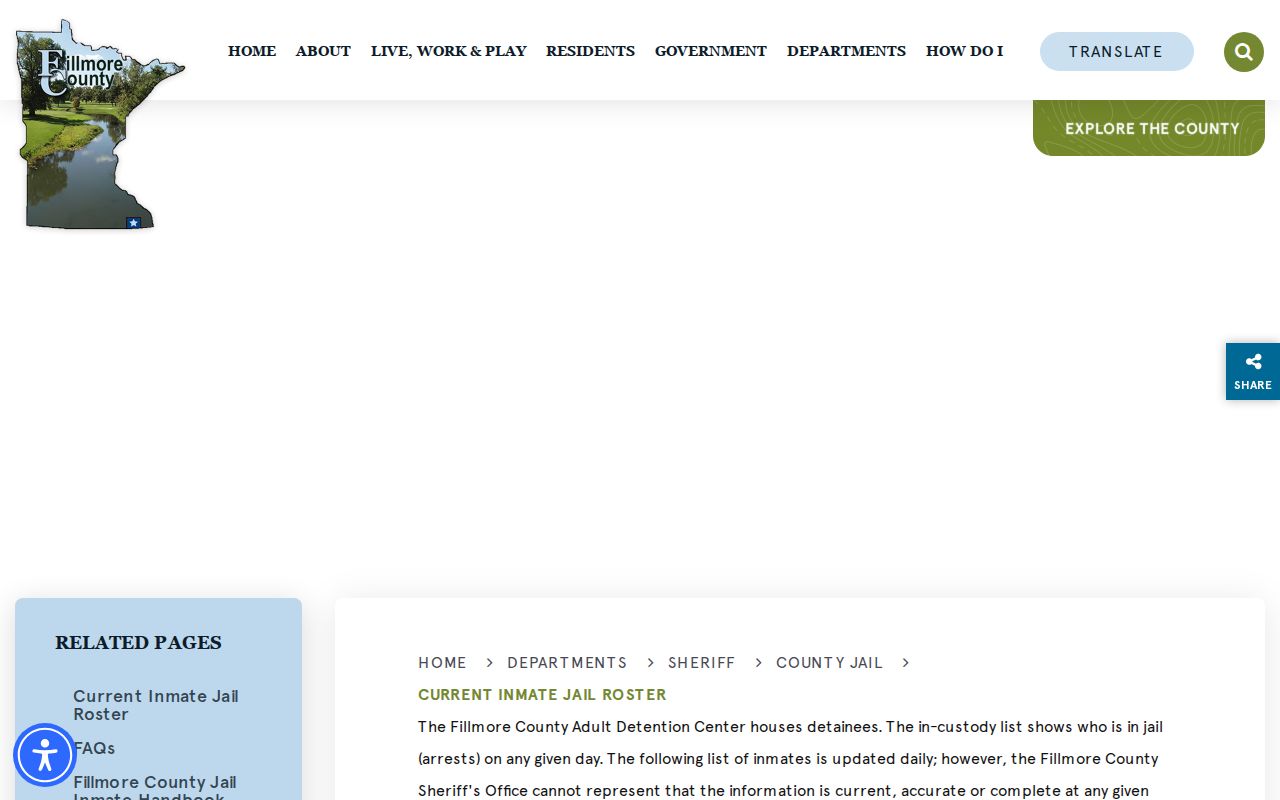
The warning explains why a roster comparison can begin a same-day check but cannot prove a release time, destination, or legal basis. A direct jail response or public event record remains the decisive source.
Note: Never combine changing roster snapshots into a homemade release list; a removed row cannot distinguish community release from transfer or correction.
Bail, Bond, and Same-Day Release
The Fillmore County jail FAQ distinguishes bail from bond. Bail is accepted in the full amount in cash. A bond is furnished by an authorized bonding agent, commonly for a fee the FAQ describes as around ten percent plus collateral or guarantees. Bail is normally returned after court requirements are met, though it may be forfeited or applied to court amounts. A bonding fee ordinarily is not returned.
Neither the Bail/Bond column nor payment alone proves the time a person left the jail. Bond-out is one release mechanism, but staff may still need to process an order or another hold. The court docket can show legal authorization. The Fillmore County release record is the source for the completed local event and its time.
- Bail
- Money paid in the full set amount to secure release subject to court obligations.
- Bond
- A promise furnished through an authorized agent, usually with a fee and possible collateral.
- Legal basis
- The official ground recorded for a release or transfer, not a conclusion drawn from the roster.
Fillmore County Work Release Status
Fillmore County has a local Work Release/Huber intake detail that can complicate a same-day result. The jail FAQ says sentenced participants report directly after court for paperwork. It names the Jail Programmer at 507-765-3874 as the fallback contact. Participation can permit time outside a secure setting while the person remains under a custodial sentence or program.
That arrangement is not the same as final discharge. VINE can also use an “unsupervised custody” label for some circumstances. Keep the actual term used by the source. Ask whether the booking ended, whether a program still controls the person’s status, and whether another agency received custody. Plain labels such as “released from this facility,” “currently listed in Fillmore custody,” and “sentence discharged” should not be swapped.
Request Fillmore County Release Data
Use the Fillmore County data-privacy hub and DATA Information Disclosure Request A when a phone check does not provide enough detail. Identify the person by full name and date of birth, add MNI or booking number if known, and give exact beginning and ending timestamps. Ask for existing data that shows the date, time, and legal basis for release. If custody moved elsewhere, request the transfer time, basis, and receiving authority instead.
Inspection of public government data is free under Minnesota law, while lawful copy charges may apply. The county pages reviewed did not provide a fixed fee or guaranteed response time for this exact request. Ask for a cost estimate and an electronic copy. A request should not demand that Fillmore County create a new “last 24 hours” report. Section 13.82, subdivision 18 does not require an agency to create or retain a special list that it otherwise does not maintain.
Fillmore County Release Outcomes
A community release ends custody at the Fillmore County Jail without an immediate handoff to another custodian. A transfer also ends the local booking, but another authority receives the person. State commitment should be checked in the MN DOC Offender Search. “Incarcerated” or “Pending Admit” is not community release. “Under Supervision” means prison custody ended while DOC jurisdiction continues.
County VINE covers local jail events. Minnesota Haven is the separate notification path for people in DOC facilities or under DOC community supervision. A federal sentence belongs in the BOP locator, while ICE’s locator is chiefly a present-custody tool. These systems answer different questions. The official Fillmore County release or transfer record establishes what ended at the jail.
The wider Fillmore County 72-Hour Release List workflow is better when the possible event spans several calendar days. It uses exact start and end times rather than pretending an official three-day feed exists.
Note: A released person normally leaves the current jail snapshot, but a missing name alone never establishes community release or final sentence discharge.