
BOP Federal Release Scope
The Federal Bureau of Prisons operates a nationwide system for people serving federal sentences. The official Fillmore County sweep found no federal prison within the county. This destination describes federal facilities across the country and the BOP release-search path, not a local institution. A person arrested or booked in Fillmore County does not enter the BOP locator merely because the case began locally.
Federal pretrial custody and federal sentenced custody also differ. The U.S. Marshals Service manages many pretrial prisoners and can place them in contract facilities. No general USMS public detainee locator was found. BOP usually becomes the main public locator after sentence and designation. If the Fillmore jail record says “transfer to USMS,” that proves Fillmore custody ended and federal custody began. It does not prove release into the community.
No single federal result reconstructs every step. The county transfer entry belongs to Fillmore County. The criminal case belongs to the federal court. A pretrial custody record may belong to USMS, while the sentence and prison placement lead to BOP. The agency that created each event should confirm it. Keeping that sequence intact avoids using a later BOP release date as though it were the date the person first left the Fillmore jail.
BOP Federal Release Search
The official BOP Inmate Locator covers federal inmate records from 1982 to the present. It supports identifier searches using a BOP register number, DCDC number, FBI number, or INS number. A name search accepts first, middle, and last name, with optional age, race, and sex fields. An identifier is usually the best way to avoid a same-name error.
Results include the person’s name, register number, age, race, sex, release date, and location or status. The locator can show a current facility, a future projected date, or a past release date with “Released” or “Not in BOP Custody.” Keep the BOP label intact. “Not in BOP Custody” is narrower than “not in custody anywhere.”
- Open the official BOP locator and choose an identifier search when a federal number is known.
- If searching by name, enter the full name and use the optional personal fields to narrow possible matches.
- Compare the register number and identity fields before opening or relying on a result.
- Record the release date exactly as shown and note whether the location reads “Released” or “Not in BOP Custody.”
- Check the federal case disposition and any known state, local, or immigration transfer record before calling the event a community release.
Older federal inmate records from before 1982 may be held by the National Archives rather than appearing in the locator. A blank result may also reflect a name mismatch, a pretrial placement outside BOP, or another coverage limit. It should not be converted into a release finding.
Search fields should be used as identity checks, not as shortcuts. A race, sex, or age field can help separate two results with similar names, while the register number ties the result to the federal record. If the identifiers do not align with the court case or county transfer, stop before drawing a custody conclusion. A public release date for the wrong person is not useful evidence.
Note: BOP locator data and federal custody status are dynamic; the cited search path was verified in the July 24, 2026 research.
BOP Federal Release Status
The Bureau of Prisons explains that a result marked “Released” or “Not in BOP Custody,” with no BOP facility listed, means the person is no longer held by BOP. A past release date is evidence of that BOP event. The agency also warns that the person may still be held in another correctional or law-enforcement system or may remain on parole or supervised release.
| BOP display | Supported conclusion | What it does not prove |
|---|---|---|
| Current BOP facility | The person is listed in BOP custody at that facility. | It does not give a completed release event. |
| Future release date | BOP displays a projected date. | The date can change and is not proof of release. |
| Past date plus Released | The BOP custody release event is recorded. | It does not rule out supervision or another custodian. |
| Not in BOP Custody | The person is not currently held by BOP. | It does not establish freedom from state, local, or ICE authority. |
| No result | No matching public locator record was found. | It does not prove release or no federal involvement. |
A future release date may change because of sentence recalculation, including applicable First Step Act calculations. It remains a projection until the event occurs and the record updates. A release to a residential reentry setting, another agency, or supervision should be described by the exact source record rather than reduced to “free.”
Time also changes the meaning of the result. A past date beside a released status documents the BOP event as recorded. A future date is only projected. When the displayed date is important to a legal or family matter, save the register number, note the date checked, and verify the current record. Do not strip away the status label or the search date when sharing the result with someone who must act on it.
BOP Federal Release Example
The official BOP locator interface shows the search routes and how a public result presents release status. The captured source illustrates the federal fields without substituting a private database for the agency record.
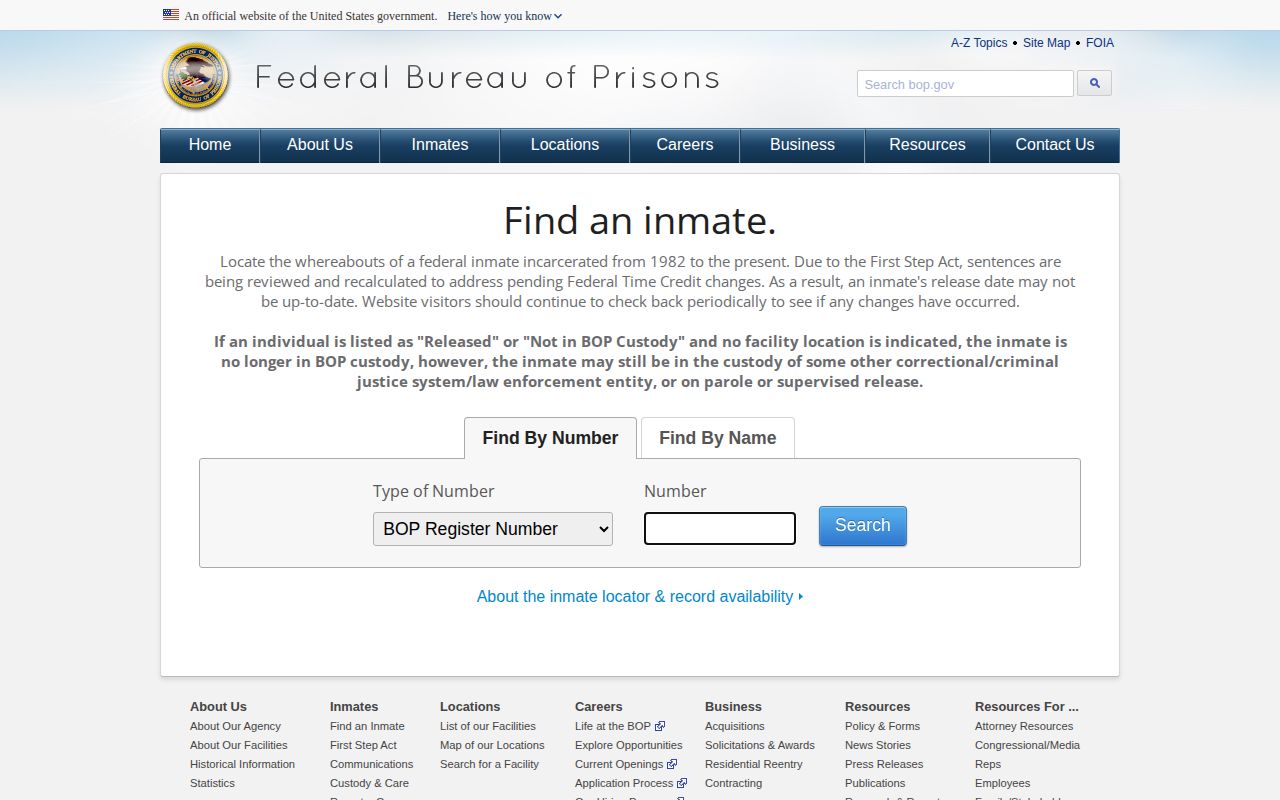
The key reading task is to keep the release date and BOP status together. The image supports a BOP custody conclusion only. A second system may still hold or supervise the person after the displayed federal event.
BOP Federal Release Records
The public locator is the quickest official route for a federal prison release from 1982 forward. When a more complete agency record is needed, a federal records request should identify the person, register number, relevant institution if known, and the exact custody or release event. BOP records are federal records. They do not belong to the Fillmore County Sheriff or Minnesota Department of Corrections.
If the subject was a federal pretrial detainee, the U.S. Marshals Service may be the record owner. The official USMS Freedom of Information Act page provides the non-urgent agency-record route. A carefully scoped request can ask for releasable existing records tied to a transfer or detention event. Federal court disposition information comes from PACER or the federal court clerk, not the county jail.
Federal Custody Records
BOP search: Nationwide Inmate Locator
Coverage: Federal inmates, 1982 to present
Older records: National Archives may hold pre-1982 files
Federal pretrial records: U.S. Marshals Service FOIA
Physical Fillmore County BOP facility: None identified
A federal court order gives legal context but may not show when an institution completed processing. For a completed BOP event, use the locator’s past release date and status, then seek the agency record when the exact basis or destination matters.
A release from BOP can also begin federal supervised release. That supervision is imposed and administered through the federal court system, not by the Fillmore County Community Corrections office and not by MN DOC. A BOP past release date therefore should not be restated as sentence expiration. The judgment and later court records supply the supervision term, while BOP supplies the prison custody event.
Note: A federal records request should ask for existing agency data and should use a register number whenever one is known.
Fillmore Federal Release Transfers
The Fillmore County Jail’s release and transfer fields provide the first link when a local booking moved into federal custody. Minnesota public arrest data can identify the transfer date, time, legal basis, and receiving person or agency. If that entry names USMS or another federal authority, follow the federal case and custody path from that point. Do not expect the county’s current roster to display the later BOP release.
A person can move through several distinct stages: Fillmore booking, transfer to a federal authority, federal pretrial detention, BOP designation after sentence, prison release, and supervised release. Not every case uses every stage. The Fillmore County released inmate search explains how to obtain the originating county event before moving into another system.
- USMS transfer
- Movement from the local jail to federal authority, not community release.
- BOP designation
- Assignment of a sentenced federal prisoner to a BOP institution or placement.
- Projected release date
- A future BOP date that may change before release occurs.
- Federal supervised release
- Court-ordered community supervision after imprisonment, distinct from BOP custody.
ICE uses a separate locator and legal system. A person who leaves BOP for immigration custody can truthfully be “Not in BOP Custody” while still detained. Likewise, BOP status does not answer a Minnesota warrant or state sentence. Follow documented transfers and use each agency only for the status it controls.
There is no researched Fillmore County BOP address, local federal prison phone, or release desk because no BOP institution was found there. Contact must follow the actual institution or agency identified in the federal record. That fact is more precise than attaching nationwide BOP information to the county jail’s Preston address.