
Understanding Fillmore County Releases
A release from the Fillmore County Jail means only that the identified booking has ended at that facility. It does not always mean unrestricted return to the community. The person may have posted bond, completed a jail term, received a court order, moved into Work Release or Huber status, or transferred to another county, MN DOC, federal custody, or immigration custody. The official current roster does not name the outcome after an entry disappears.
The record must answer who left, which booking ended, when Fillmore County custody ended, the legal basis, and whether another person or agency received custody. Minnesota law makes the core release and transfer facts public at the originating law-enforcement agency. That is stronger proof than comparing two roster snapshots. A court record can explain the order behind the event, but it does not show the moment jail staff completed release processing.
- Release
- Custody ends at a facility, either into the community or under a new legal status.
- Transfer
- One custodian hands the person to another custodian. This is not a community release.
- Supervised release
- A state prisoner serves part of an executed sentence in the community under MN DOC authority.
- Discharge
- The sentence or supervision obligation ends. Discharge can occur well after a jail release.
Fillmore County Release Paths
The legal basis controls the next search. Fillmore County publishes bail and bond information for the current booking, but that field is not a completed release time. Probation can begin after a court disposition. A prison transfer moves the record to MN DOC. Federal or ICE transfers require still other systems.
| Path | Meaning | Best next source |
|---|---|---|
| Bail or bond | Release may follow once security and all holds are cleared. | Jail release entry and court case |
| Time served or court order | Local custody ends under the judgment or later order. | County release data and MCRO |
| Probation | The person may live in the community under court-ordered local supervision. | MCRO and Community Corrections |
| MN DOC transfer | County custody ends, but state imprisonment begins. | MN DOC Offender Search |
| Federal or ICE transfer | Another authority receives custody. | County transfer data, then federal tools |
Fillmore County Release Record Fields
The county web roster shows booking data, not a released-person archive. Minnesota Statutes section 13.82, subdivision 2 makes the release date, time, and legal basis public arrest data. The same provision covers the date, time, legal basis, and receiving authority for a transfer. A narrow request should connect those facts to the exact Fillmore County booking.
| Field | What it establishes |
|---|---|
| Name and identifying data | Which person the event concerns |
| Booking number or MNI | Which Fillmore County intake is tied to the event |
| Release date and time | When county custody for that booking ended |
| Legal basis | The maintained reason for release or transfer |
| Receiving person or agency | Whether custody continued elsewhere |
| Booking photograph | The image linked to the arrest process, not current status or guilt |
Do not assume every field appears on one screen. Request existing public data rather than demanding that staff create a new narrative. Sensitive medical, psychological, victim, juvenile, sealed, or active-investigation information may be withheld or redacted under other parts of Minnesota law.
Request Fillmore County Release Records
Start with the county data privacy and records-request hub. Use DATA Information Disclosure Request A and ask for the existing public event. The county has not published a reliable fixed response time or universal fee for this exact request. Inspection of public data is free; lawful copy costs may apply, so request an estimate before copies are made.
- Give the full name and date of birth. Add the MNI or booking number if known.
- Ask for the intake date and the date and time Fillmore County custody ended.
- Ask for the legal basis. If it was a transfer, request the receiving person or agency.
- Request the existing booking image and public booking identifier only if needed.
- Prefer electronic inspection or an electronic copy, and narrow the date range if staff seek clarification.
901 Houston Street NW
Preston, MN 55965
507-765-3874, sheriff office option 1
Monday through Friday, 8:00 a.m. to 4:30 p.m.; dispatch operates at all hours
For a state-prison discharge, request the MN DOC record. Federal prison records go through BOP channels, while court-certified papers come from Court Administration. A person disputing the accuracy of government data about themselves may use Minnesota Statutes section 13.04, subdivision 4. That route differs from expungement or changing a judgment.
Law Behind Fillmore Release Records
Minnesota Statutes section 13.82 is the main release-data rule. Subdivision 2 identifies the public release and transfer fields. Subdivision 18 says the law does not force an agency to create, collect, or maintain a list that it otherwise does not keep. That matters because Fillmore County has no official rolling released-inmate feed or archive.
Public access to an existing event does not require Fillmore County to build a custom 24-hour or 72-hour report.
Section 13.85 can protect corrections data that would expose sensitive personal information or create danger. Section 13.82, subdivision 26 makes an existing booking photograph public, subject to temporary withholding when release would harm an active investigation. Public does not mean permanently posted online.
Bonding Out in Fillmore County
The Fillmore County Jail FAQ draws a local distinction between bail and bond. Bail is accepted in the full cash amount. A bond is furnished by an authorized bonding agent, commonly with a fee the county describes as around ten percent plus collateral or guarantees. That description is not a guaranteed price for every case.
Cash bail is normally returned after court duties are met, but it can be forfeited for nonappearance or applied to court obligations. A bonding fee is generally not returned. Neither a bail figure nor proof that a bond was arranged establishes that staff finished the release. Other holds and processing may remain. Confirm the completed event with the jail release entry and the court record.
Fillmore Release and Court Timing
Fillmore’s jail FAQ says booking paperwork goes to Court Administration for the daily jail calendar. It also explains local 48-hour and 36-hour initial-review calculations, including how Sundays, holidays, and the arrest day affect the 36-hour count. Those rules place a booking in court context. They do not create a promised release time.
Use Minnesota Court Records Online to find the case number, charges, disposition, sentence, hearings, and accessible documents. A dismissal, sentence, or release order can explain why custody should change. The Fillmore County release record remains direct proof of when the jail processed the event.
The official MCRO screen shows the available case-search filters.
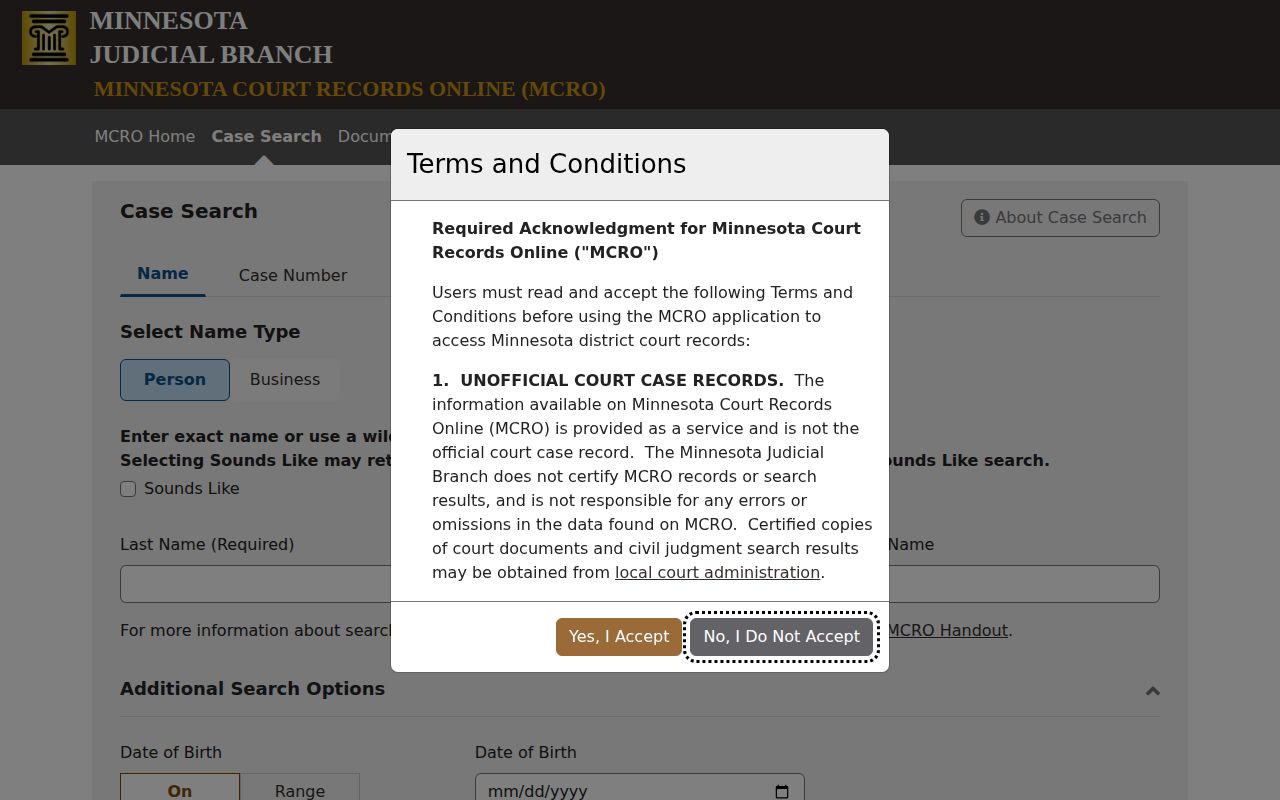
Match the court number and booking identifier before relying on a same-name result.
Fillmore Work Release Status
Fillmore County documents a Work Release or Huber intake path. Sentenced participants report after court for paperwork or contact the Jail Programmer through the jail number. Participation is not the same as final discharge. It can remain a form of custody with permission to leave for approved work or another authorized purpose.
VINE can also use an “unsupervised custody” event label. Keep that wording intact. Do not convert it to “free” or “sentence discharged.” Ask which event the jail recorded, whether the identified booking ended, and whether another custody or supervision obligation continues.
Fillmore County Release Supervision
Fillmore County operates its own Community Corrections department in the courthouse. It handles assigned adult felony, gross-misdemeanor, misdemeanor, and pretrial supervision, and it publishes named local agents. That creates a direct follow-up when a court record says a released person received local probation or supervision.
The office directory is not a person-search system. A missing jail name does not justify claiming that the person is on probation or calling an agent without a case basis. First read the sentence in MCRO. For a state-prison case, use the MN DOC record and its public supervision fields instead of assuming the local office has authority.
Fillmore Release Versus Expungement
Leaving the Fillmore County Jail and completing a sentence are different milestones. Minnesota automatic-expungement waiting periods for qualifying convictions run from discharge of sentence, not simply the day a person walked out of jail. Depending on the qualifying category, the researched waiting periods can be two, three, four, or five years, with exclusions and new-case rules.
Minnesota Judicial Branch expungement help explains the process. Expungement seals government records; it does not destroy the event. A case can stop appearing through ordinary MCRO access while a release once occurred. It also does not promise deletion of independent copies. Quote the discharge date from the correct sentence record before applying a waiting-period rule.
Find a Released Fillmore Inmate
Begin with the official source that covers the likely custodian. Fillmore County has no released tab, name search, archive, or official recent-release feed. The current roster is still a useful lead because it supplies the booking number, MNI, intake date, charge data, photo, and bail or bond field. Its own warning says updates are daily and later bookings or releases may not yet appear.
- Check the Fillmore current-roster gateway. Treat presence as a dated custody lead and absence as inconclusive.
- Call the jail with a precise name and booking identifier. Ask whether the booking ended by community release or transfer.
- Search MN DOC if sentencing or transfer points to state prison. Read custody, supervision, and discharge labels exactly.
- Check MCRO for the court disposition, then use BOP or ICE only when the case indicates federal or immigration custody.
- File a county request for the existing release or transfer fields when no public screen resolves the event.
A vanished roster name can mean release, transfer, data correction, or lag. It is not proof of a community release.
The official gateway warning is visible on the Fillmore County roster source.
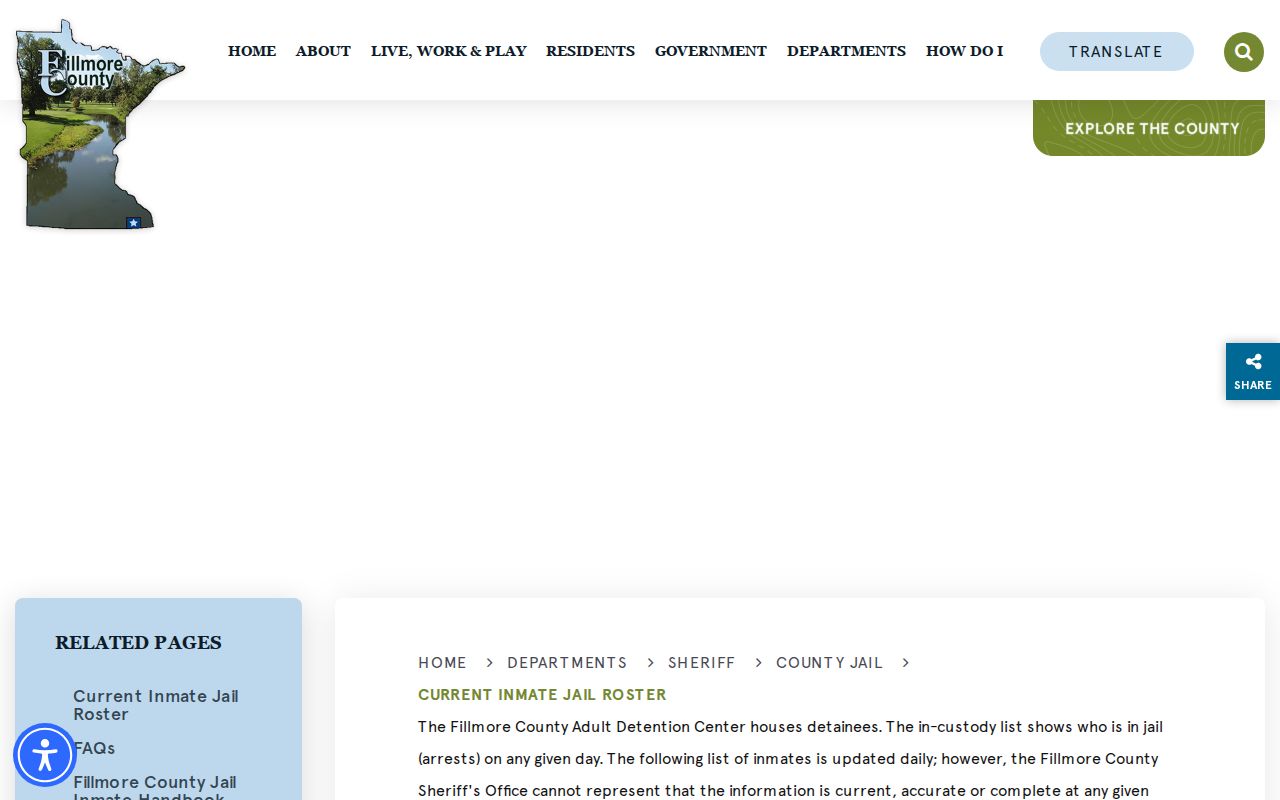
The daily cadence explains why direct confirmation and a dated release record matter after a name disappears.
MN DOC Fillmore Release Search
The MN DOC Offender Search covers people committed to the Commissioner of Corrections. It is not a historical Fillmore County jail roster. A person can be released from prison and appear as under supervision because the executed sentence continues in the community. Final discharge is a later status.
| Search field | Use | Limit |
|---|---|---|
| MN DOC number | Best match when known | Applies to the state corrections record |
| First and last name | Finds name-based candidates | Compare identity details before relying on a result |
| Status | Shows custody or supervision posture | “Under Supervision” is not final discharge |
| Date fields | May show anticipated or release-related dates | Labels and dates vary and can change |
| Agent or office | May identify public supervision contacts | Availability varies |
The state interface can show identifying details, sentence information, status, and applicable dates. Always record the field label and as-of context. A projected date is not proof that release occurred.
The official MN DOC search form shows the current entry fields.
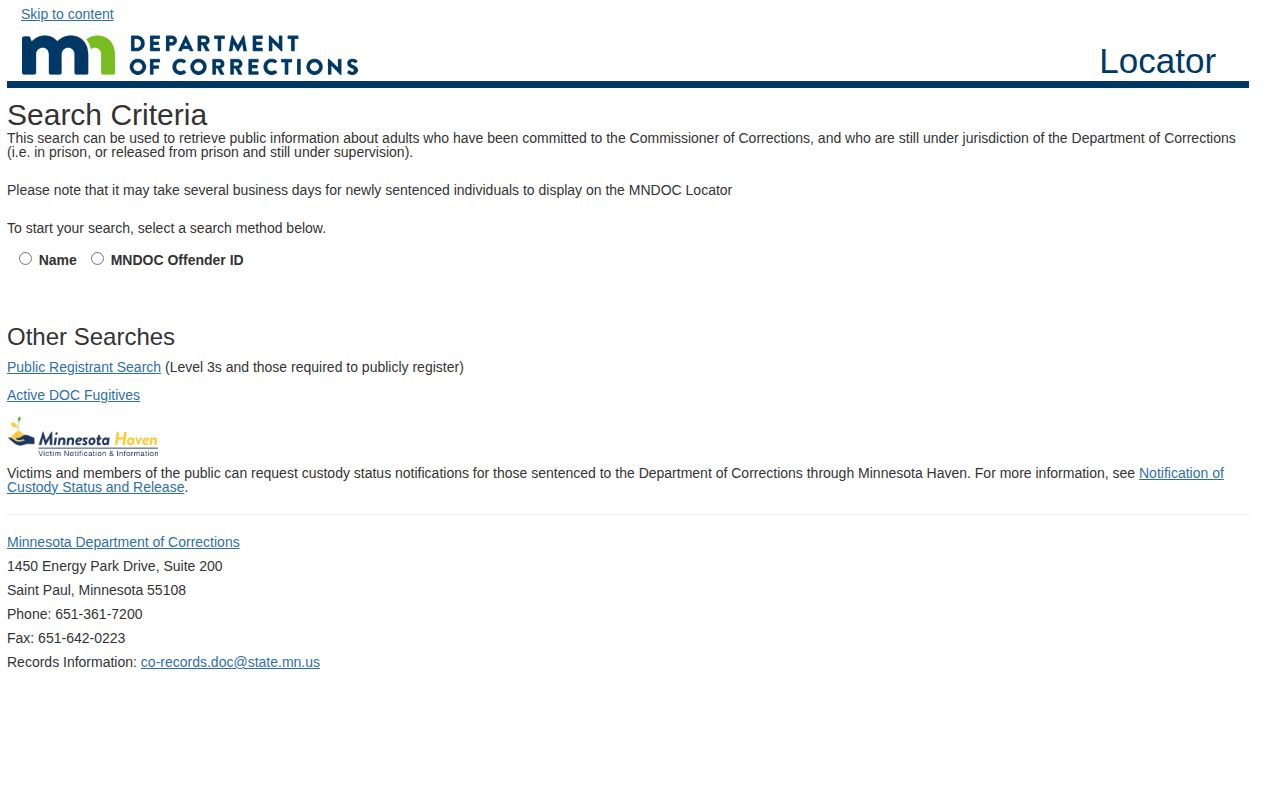
Use the DOC number when available, then compare the returned identity and sentence rather than relying on a name alone.
Fillmore County Recent Release Limits
As of the July 24, 2026 source review, no official Fillmore County 24-hour, 48-hour, or 72-hour released-inmate feed was found. The live product is a timestamped “In Custody” snapshot. It has no released tab, archive selector, date-range control, or name box. A former entry is unavailable after removal, and the county publishes no post-release retention promise for that screen.
To check a one-day window, request existing events within an exact date and time range. That request does not compel staff to create a new list. For one known person, a name, date of birth, MNI or booking number, and narrow dates produce a clearer request than asking broadly who left.
Fillmore Release Supervision Records
Fillmore Community Corrections covers assigned local probation and pretrial matters. A known probation sentence can lead to that office, but its directory is not a public list of released people. Minnesota parole and supervised release have different state meanings. The Supervised Release Board handles only specified cases, while many determinate prison sentences move into supervised release under statute.
The Fillmore County parole and probation page separates those routes. Use MCRO for a probation sentence, MN DOC for state-prison supervision, board minutes for a covered discretionary decision, and the final discharge record when the sentence has ended.
Fillmore Release Alerts and Custodians
Minnesota VINE covers county jails and detention facilities, including Fillmore. It supports a one-person custody check and alerts for release, bond release, transfer, escape, death, record purging, and certain custody changes. The county warns not to rely on VINE alone. If the person entered a state prison or DOC supervision, use Minnesota Haven instead.
Federal systems divide again. The BOP Inmate Locator covers federal inmates from 1982 forward and can show a past release date with “Released” or “Not in BOP Custody.” That does not rule out state, local, immigration, or supervision authority. ICE’s locator is mainly for present ICE custody, not released-person history. A blank result cannot identify release, removal, transfer, a spelling mismatch, or delay.
Compare Fillmore Release Sources
Each system proves only the event it was built to record. Keep the source label attached to every status.
- Fillmore roster
- Shows a person currently listed in county custody as of the snapshot, but not why or when a missing person left.
- County release record
- Shows the release or transfer date, time, legal basis, and receiver, but not the person’s later status in another system.
- MN DOC search
- Shows state custody, supervision, and applicable dates, but not the Fillmore County jail processing time.
- MCRO
- Shows charges, disposition, sentence, and court events, but not the physical door-release time.
- BOP locator
- Shows federal custody history and a release date, but not freedom from every other authority.
- ICE locator
- Shows qualifying present ICE custody, but does not provide a historical community-release record.
Fillmore County Release Facilities
The Fillmore County Jail / Adult Detention Center is the only locally documented custodial facility found. Its record distinguishes community release from transfer. No state, federal, or ICE institution was identified as physically located in Fillmore County, but people whose local booking ends can still enter those systems.
- Minnesota state correctional facilities, statewide, use the MN DOC Offender Search and Haven.
- Federal Bureau of Prisons facilities, nationwide, use the BOP locator and federal record channels.
- The ICE detention network uses the current-custody-focused ICE locator and ERO contacts.