
Fillmore County Mugshot Public Records
A booking photograph records a person’s appearance during the arrest and booking process. It does not prove guilt, establish the outcome of a charge, or show whether the person is now in custody. Minnesota law addresses the image as government data. Minnesota Statutes § 13.82, subdivision 26 defines a booking photograph and makes an existing image public, subject to temporary withholding when access would adversely affect an active investigation.
Public status does not require the Fillmore County Sheriff to keep a photo in an online gallery. The county’s live roster is a current-custody snapshot. Once a person is removed, the public image may still exist in the agency record even though the web thumbnail is gone. The data request process, not a guessed roster-retention period, is the reliable route after release.
A release record and a mugshot answer different questions. The release entry can show when custody ended and the legal basis. The photo documents the booking image. Linking them requires the same booking number, MNI, name, and date of birth where available. A face alone is not a safe identity match.
Fillmore County Mugshot Access Channels
Fillmore County has a narrow official photo path. The live jail endpoint has a Photo column, but only for people in its current “In Custody” dataset. No sheriff release app, released-photo feed, archive control, or online photo-retention policy was found. A county data request becomes the main channel after the current entry disappears.
| Channel | Has a photo? | How to access it |
|---|---|---|
| Fillmore current roster | Yes, for current entries | Use the official county gateway and match the MNI or booking number. |
| Fillmore released archive | No official archive found | Request the existing booking image from the county after removal. |
| Sheriff mobile app | No official app found | Do not treat an unaffiliated jail app as a Fillmore County source. |
| County data request | Yes, if the image exists and is public | Use DATA Information Disclosure Request A and identify the booking. |
| MN DOC Offender Search | May show a DOC image | Search a person committed to state corrections by DOC number or name. |
| Third-party category | May preserve copies | Use only as a lead and verify all facts against official records. |
| News or agency story | Sometimes | Check the date and source; publication is not proof of present custody. |
VINELink is designed for status and notification, not as a dependable released-photo archive. The court record can explain the case and disposition, but MCRO is not the sheriff’s booking-image file. Each channel has its own scope. A useful search keeps the image source separate from the proof of release.
Fillmore County Roster Mugshot Limits
The official Fillmore County roster gateway describes a list of people in jail on a given day. The linked endpoint shows Photo, MNI, Name, Sex, Age, Booking Number, Intake Date, Charges, and Bail/Bond. Those fields support a current-booking match. They do not include release date, release time, release reason, destination, or a past-photo gallery.
The county says the roster is updated daily and warns that bookings and releases may occur after the update. A timestamp adds context but does not make the screen real time. If an entry later disappears, the only safe statement is that the person is not shown in that snapshot. Release to the community, transfer, another custody arrangement, or a data update can all remove the entry. Fillmore publishes no official rolling feed, as the 24-Hour Release List explains.
The captured official endpoint demonstrates the Photo column and current-only design. Live identities and thumbnails should not be reproduced merely as examples.
Open the current Fillmore Jail “In Custody” source to check its present field structure.
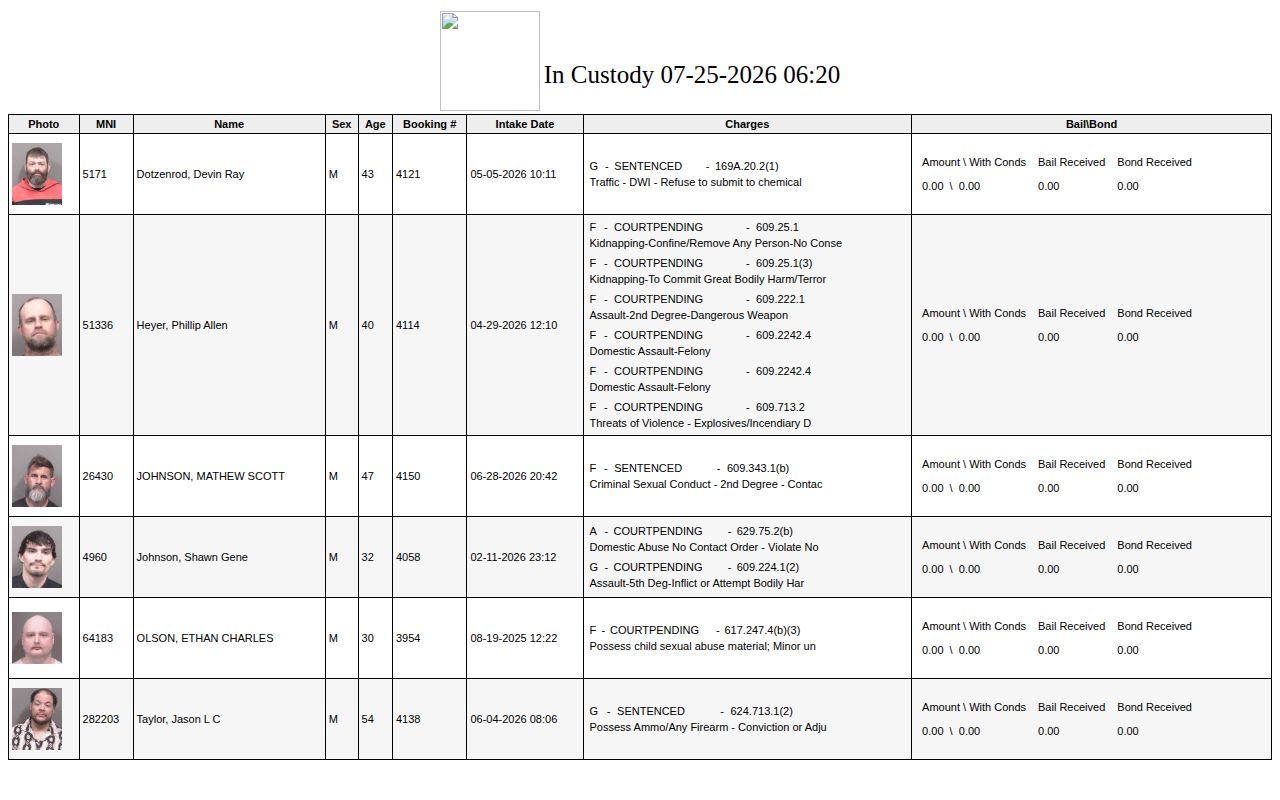
The image shows the roster structure, not a released-person photo list or proof of anyone’s current status.
Note: Roster fields were reviewed July 24, 2026; save the MNI or booking number because names and photographs alone can mislead.
Request Fillmore County Booking Photos
Start at the Fillmore County data-privacy hub and use DATA Information Disclosure Request A. Address the request to the responsible county or sheriff data authority as the county directs. Ask for an existing record. The published research did not establish one fixed turnaround or universal fee for this exact request, so request an estimate and preferred delivery method instead of assuming a price. The Fillmore County release-record process covers the full custody-event request.
- Identify the person by full name and date of birth. Add the booking number or MNI if known.
- State the booking date or a narrow date range so the county can locate the correct event.
- Ask for the existing booking photograph and public booking or intake identifier tied to that event.
- If release context is also needed, request the date, time, and legal basis for release or transfer and the receiving agency when applicable.
- Cite Minnesota Statutes § 13.82, subdivisions 2 and 26, and ask for electronic inspection or an electronic copy.
- Ask for a cost estimate before copies are made. Inspection of public government data is free, while lawful copy costs may apply.
The county need not create a new gallery, edit a custom image, or build a release report that it does not maintain. Subdivision 18 says the law does not require creation, collection, or maintenance that is not otherwise required. A narrow request for an existing photo and identified booking is more precise and easier to process.
If the image is temporarily withheld due to an active investigation, that does not make every booking photo permanently private. Ask the county which legal basis applies and whether access can be reconsidered when the reason ends.
Fillmore County DOC Offender Photos
A person sentenced in a Fillmore County case may move from the county jail to the Minnesota Department of Corrections. The MN DOC Offender Search can include a public corrections image for a person still under DOC jurisdiction. Search by MNDOC Offender ID when known, or match a name result with birth date and other identifiers.
The DOC image is not necessarily the Fillmore arrest photograph. It belongs to the state corrections record. A county detainee who never entered state corrections will not have a DOC record merely because the booking occurred in Fillmore County. Likewise, the public locator can stop returning a person after final discharge because its scope is limited to people still under DOC jurisdiction.
Status must be read apart from the photo. “Incarcerated” describes state custody. “Under Supervision” means the person has left prison while DOC authority continues. The image establishes neither current jail custody nor final sentence outcome. Use the state status fields and the county release or transfer entry to explain the route.
Fillmore County Mugshot Secondary Sources
Commercial mugshot publishers and other aggregators can preserve stale photos, merge people with similar names, omit dispositions, and make an old booking look current. No such service was found reliable enough to recommend for Fillmore County release confirmation. The category may explain where a copy surfaced, but no commercial mugshot or data-broker link should replace an official record.
A sheriff announcement or local news report can also include an arrest-related image. No systematic Fillmore County released-photo news stream was found. Publication date is not custody status, and an arrest report does not establish how the case ended. Match any secondary image to the county booking identifier, then use the release record and MCRO disposition for context.
Payment-based removal claims should be approached with care. The official sweep found no enacted Minnesota mugshot-specific pay-to-remove statute. A proposal from 2014 did not become the current arrest-photo rule, and current Minnesota Statutes § 325E.80 concerns a different topic. No removal service can guarantee the effect of a government order on every independent copy.
Fillmore County Released Photo Policy
The live Fillmore roster serves thumbnails only as part of its current-custody dataset. The county publishes no released-photo gallery and gives no online photo-retention window. That is the key local policy finding. Public access under state law remains possible even when continuous online publication does not.
After an entry drops, identify the booking and request the existing image through the county process. The legal path rests on Minnesota Statutes § 13.82, subdivision 26, while subdivision 2 supplies the core release and transfer fields needed to avoid presenting the photo without status context. A mugshot should not be used as the sole match or as evidence of a completed release.
Fillmore County Mugshots After Expungement
Minnesota criminal expungement seals and restricts disclosure of government records; it does not destroy them. Under chapter 609A, qualifying automatic-expungement waiting periods for convictions run from discharge of sentence, not merely from the day the person walked out of the Fillmore County Jail.
The distinction can span years. A person may leave jail and then remain on probation or supervised release before discharge of sentence occurs. A sealed case can later vanish from a remote court search, but that does not mean the booking event never happened. It also does not justify a promise that every independent copy will disappear.
For inaccurate government data about oneself, Minnesota Statutes § 13.04, subdivision 4 provides a separate challenge to accuracy or completeness. Identify the exact field, explain the error, and supply the source record. That route differs from expungement and from disputing the court judgment itself.
Note: Use the discharge-of-sentence date when studying an expungement waiting period, because jail release may occur much earlier.
Verify Fillmore County Released Mugshots
A careful match uses full name, date of birth, booking number or MNI, booking date, and the agency that made the image. The photo is supporting evidence, not the sole identifier. If the current roster still shows the person, note the roster timestamp and the county’s daily-update warning. If it does not, request the booking and release fields instead of labeling the person released from absence alone.
MCRO can add the case number, charges, disposition, sentencing entries, and public orders. Yet the court record does not prove the minute jail processing ended. The Fillmore County release or transfer entry answers that point. For a state commitment, the MN DOC record explains whether the person is incarcerated, under supervision, or in another DOC status.
The official-source chain preserves dignity and accuracy: photo source, booking identifier, release or transfer record, and case disposition. A recently published image can still be old. A state DOC photo can differ from the county booking image. A released-photo search is complete only when the source and custody event have been kept distinct.